

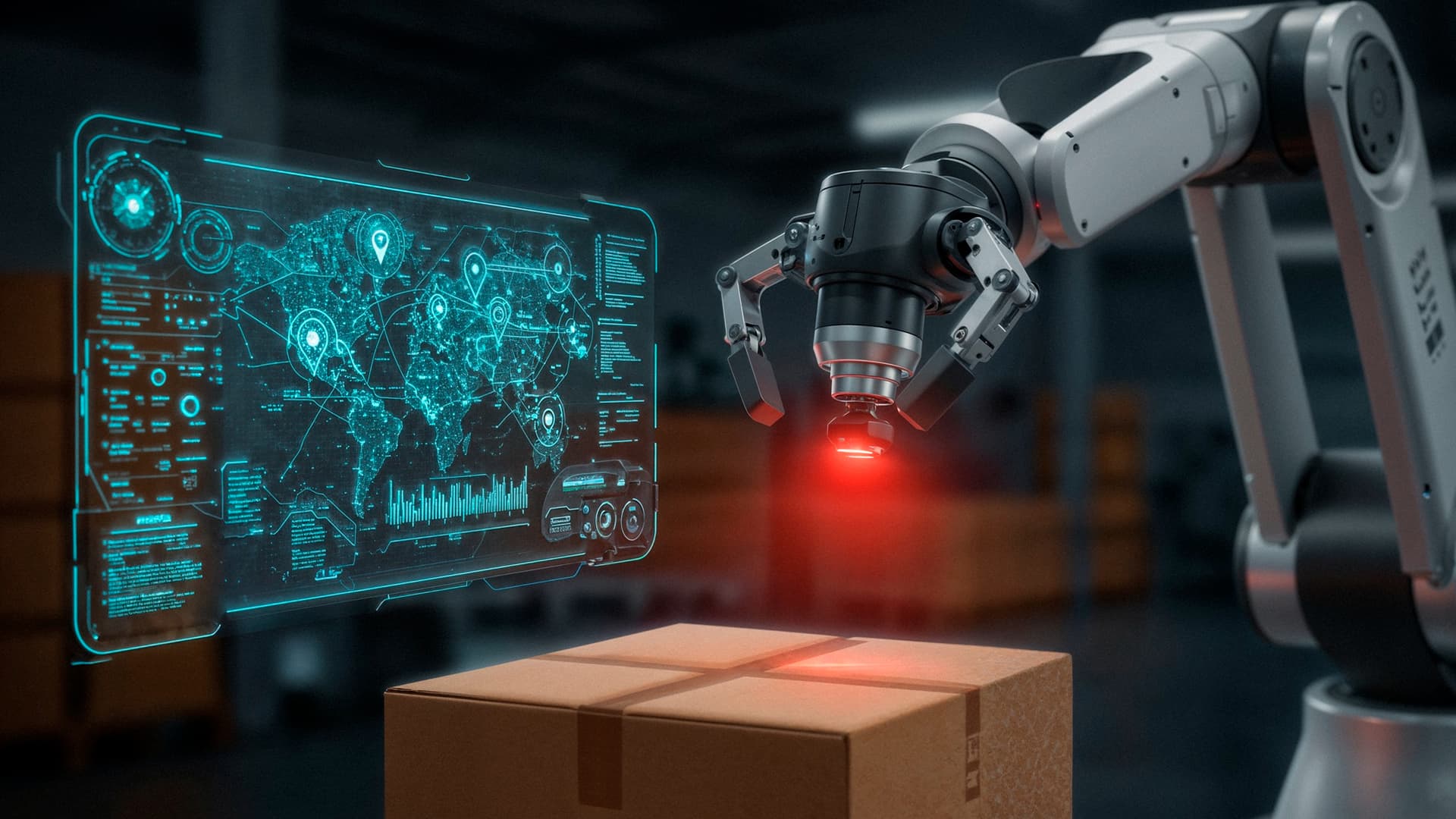
Global supply chains are under more pressure than at any point in recent decades. Port disruptions, raw material shortages, shifting trade policies, and consumer demand volatility have exposed the limits of traditional planning systems built on historical averages and human intuition. The organizations navigating these conditions most effectively share a common capability: they have operationalized AI in supply chain processes to move from reactive management to continuous, data-driven decision-making.
This guide covers where artificial intelligence delivers measurable value in manufacturing and logistics, what the adoption journey actually looks like, and how to evaluate whether your current data infrastructure is ready to support it.
The Business Case: What AI Delivers in Supply Chain Operations
Before examining specific applications, it is worth establishing the scale of impact that organizations are reporting. McKinsey’s research on supply chain digitization found that companies fully deploying AI-driven forecasting and inventory management reduced supply chain costs by 15 to 20 percent, decreased inventory levels by up to 35 percent, and improved service levels by 65 percent compared to baseline performance. Gartner predicts that by 2026, more than 75 percent of large enterprise supply chain management applications will use embedded AI and advanced analytics.
These are not projections about future technology. They are outcomes from manufacturers and logistics operators running production systems today.
The financial case rests on three levers.
First, precision: AI models process hundreds of variables simultaneously, producing forecasts that are materially more accurate than what Sales and Operations Planning (S&OP) teams can produce manually.
Second, speed: automated systems detect anomalies in real time rather than discovering them in the next reporting cycle.
Third, consistency: machine learning models do not have bad days, do not miss shifts, and do not apply different judgment criteria to the same data depending on who is reviewing it.
Where AI in Supply Chain Creates the Most Operational Value
Demand Forecasting and Inventory Planning
Inventory management sits at the intersection of cash flow and customer service. Overstock ties up working capital and generates write-offs. Stockouts damage client relationships and invite churn. The traditional approach of setting fixed reorder points against a safety stock buffer was designed for a more stable world.
AI in supply chain forecasting works differently. Instead of relying on a rolling average of historical sales, modern platforms such as Blue Yonder, Kinaxis, and o9 Solutions ingest external signals alongside internal data. Weather patterns, macroeconomic indicators, social sentiment, supplier lead time variability, and geopolitical risk assessments all feed into probabilistic demand models. The output is not a single forecast number but a range of scenarios with associated confidence levels, allowing planners to make inventory decisions based on risk tolerance rather than a single point estimate.
The practical result is a supply chain that can operate closer to Demand-Driven MRP (DDMRP) principles, buffering dynamically where variability is highest and running leaner everywhere else.
Predictive Maintenance and Asset Uptime
An unplanned equipment failure on a production line does not simply pause output. It triggers a cascade: expedited parts procurement, overtime labor costs, delayed customer shipments, and potential contractual penalties. For capital-intensive industries like automotive, aerospace, or food processing, the fully loaded cost of a single major downtime event can run into hundreds of thousands of dollars.
Predictive maintenance addresses this through IoT sensor networks installed on critical machinery. Accelerometers, thermal sensors, and acoustic monitors capture real-time data on vibration signatures, operating temperatures, and sound profiles. Machine learning models trained on historical failure data identify the early signatures of component degradation, often flagging a likely failure 72 to 96 hours before it would become a production stoppage.
This transforms maintenance from a reactive discipline into a planned intervention. Teams schedule downtime at moments that minimize production impact, extend the service life of expensive capital assets, and reduce the total cost of maintenance per unit produced. SAP Predictive Asset Insights and IBM Maximo are among the enterprise platforms enabling this capability at scale.
Automated Quality Inspection
High-speed production lines generate product at a rate that makes comprehensive manual inspection physically impossible. A line producing 500 units per minute cannot be monitored by human inspectors with sufficient consistency to catch microscopic surface defects, dimensional deviations, or color variations that fall outside specification.
Computer vision systems powered by convolutional neural networks inspect every unit at line speed. Unlike a human inspector, who applies judgment that varies with fatigue and attention, a trained vision model applies identical criteria to the first unit of the shift and the ten-thousandth. These systems do not just classify units as pass or fail. They log the type, location, and frequency of every defect, feeding that data back into a process monitoring dashboard that identifies whether a specific machine, tool, or raw material batch is the root cause.
The result is a quality system that improves continuously. Scrap rates decline. Warranty claims fall. And the production data generated becomes an asset in its own right, informing future process optimizations and supplier negotiations.
Logistics Optimization and Network Design
Transportation and last-mile delivery represent a significant share of total supply chain costs, and they are among the most amenable to AI-driven optimization. Static routing tables and fixed carrier relationships were adequate when volumes were predictable. Today, dynamic optimization engines recalculate load plans, carrier assignments, and delivery routes in real time based on live traffic data, carrier capacity, fuel cost fluctuations, and time-window constraints.
At the network design level, AI models can simulate the cost and service implications of adding, removing, or relocating distribution centers. Running a scenario in which, a primary warehouse goes offline or a regional carrier withdraws capacity used to require weeks of manual analysis. With a properly configured digital twin environment, the same analysis runs in hours.
The Three Stages of AI Adoption in Manufacturing
Understanding where an organization sits on the adoption curve helps prioritize investment and set realistic expectations about timelines.
Stage one is data consolidation.
Most manufacturing operations begin with fragmented data environments: procurement data in one ERP, production data in a separate MES, logistics data in a carrier portal, and quality data in a local spreadsheet. No AI model performs well on siloed inputs. The foundational work at this stage involves creating a unified data layer, establishing master data management protocols, and ensuring that the systems producing data are writing to a common schema.
Stage two is targeted automation.
With a reliable data foundation in place, organizations identify the two or three operational pain points where AI can deliver the clearest return. A manufacturer with chronic stockouts might prioritize demand forecasting. A plant with high maintenance costs might start with predictive asset monitoring. At this stage, the goal is demonstrable ROI from specific use cases, not enterprise-wide transformation.
Stage three is connected intelligence.
Individual AI applications begin to share data and inform one another. Demand signals from the forecasting model influence production scheduling. Quality defect data feeds back into supplier scorecards. Maintenance alerts integrate with production planning to minimize disruption. At this stage, the supply chain begins to exhibit self-correcting behavior, adjusting to new information without requiring manual intervention at every decision point.
Most organizations spend 18 to 36 months moving from stage one to stage two before the connected intelligence model becomes achievable.
Why Data Architecture Determines Whether AI Succeeds or Fails
The single most common reason AI in supply chain projects underperform is not the choice of algorithm or platform. It is the state of the underlying data. A demand forecasting model trained on inconsistent historical data will produce inaccurate forecasts regardless of the sophistication of the model architecture.
Three data quality issues appear repeatedly in manufacturing environments. The first is definitional inconsistency, where the same SKU carries different identifiers across systems, making it impossible to join records across departments accurately. The second is incompleteness, where sensor networks have gaps in coverage, or where manual data entry has left fields empty or incorrectly populated. The third is latency, where data from production systems is batched and uploaded overnight rather than streamed in real time, which renders predictive models less useful for time-sensitive interventions.
Addressing these issues requires investment in data governance before AI deployment begins. Organizations that skip this step typically discover the problem six months into an AI project when the model's outputs fail to match operational reality. A realistic AI readiness assessment covers data availability, data quality scoring by source system, integration architecture, and the computational infrastructure needed for model training and inference.
Managing Risk and Building Resilience with AI in Supply Chain
The 2021 Suez Canal blockage, the 2022 semiconductor shortage, and the ongoing reconfiguration of trade routes between Asia and Western markets demonstrated a structural truth about global supply chains: low-probability, high-impact events occur with enough regularity to warrant systematic preparation.
AI in supply chain risk management operates across two time horizons. In the near term, anomaly detection models monitor supplier performance, logistics lead times, and commodity price feeds continuously, alerting planners when a pattern signals elevated risk before it materializes as a disruption. In the medium term, digital twin environments allow organizations to model specific disruption scenarios and develop contingency protocols in advance.
A digital twin is a computational model of the physical supply chain that reflects current inventory positions, supplier relationships, logistics capacity, and production constraints. When a planner asks what happens if a tier-one supplier reduces capacity by 30 percent for 60 days, the digital twin can calculate the downstream impact on production schedules, customer service levels, and cash flow. This turns scenario planning from an annual exercise into a continuous operational capability.
Ethical sourcing and ESG compliance add a further dimension to supply chain risk. Regulatory frameworks in the European Union and the United States now require companies to conduct due diligence on the labor and environmental practices of suppliers, sometimes extending to tier two and tier three. Manual traceability at this depth is not feasible at scale. AI-powered supply chain traceability tools can map the provenance of raw materials and components, flag suppliers with unresolved compliance issues, and generate the documentation required for ESG reporting frameworks including GRI and TCFD.
What to Evaluate Before Implementing AI in Your Supply Chain
The decision to implement AI in supply chain processes should begin with an honest assessment of organizational readiness rather than a technology selection exercise. The following areas are worth examining before any platform evaluation begins.
Data centralization is the starting point.
If procurement, production, logistics, and sales teams are not drawing from a shared source of truth for inventory and demand data, the fragmentation will limit every AI initiative downstream.
Systems connectivity matters equally.
The value of a predictive maintenance program depends on whether machinery is instrumented with sensors that feed data to a central monitoring system. A factory floor where equipment diagnostics are read manually on a weekly basis is not ready for predictive AI without hardware investment.
Vendor integration depth affects forecasting quality significantly.
AI demand forecasting models improve when they have visibility into supplier lead times and available capacity. Organizations whose suppliers cannot share structured data through EDI or API connections will need to account for that gap in their project scoping.
Computational infrastructure should be evaluated alongside the use case.
Applications requiring real-time inference at the edge, such as vision-based quality inspection, require different infrastructure than batch forecasting runs in the cloud. The two are not interchangeable, and misaligning the use case with the infrastructure is a common source of project delays.
Finally, internal capability needs an honest assessment.
AI tools require ongoing monitoring, model retraining as conditions change, and integration maintenance. Organizations without data engineering or ML operations capability should factor the cost of building or partnering for that expertise into their total cost of ownership calculation.
If your organization is working through these questions and needs a structured approach to assessing AI readiness and implementation strategy, Trifleck’s technology consulting team works with manufacturers and logistics operators at each stage of this process. Contact us to discuss where your operation stands and what a realistic roadmap looks like.
Building Operations That Move as Fast as the Market
The manufacturers and logistics operators that will lead their sectors over the next decade are not necessarily those with the largest capital budgets. They are the organizations that can convert operational data into decisions faster than their competitors.
AI in supply chain management is the mechanism that makes this possible. It closes the gap between when market conditions change and when the operation responds. It shifts maintenance from a cost center into a precision function. It turns quality inspection from a sampling exercise into a comprehensive data stream. And it gives planning teams the scenario modeling capability to prepare for disruptions rather than react to them.
The organizations that treat this transition as a strategic priority, and invest in the data foundations that make AI applications perform reliably, will be the ones setting the standards that others follow. Trifleck works with manufacturing and logistics businesses at every stage of this journey. If you are evaluating where to start or how to accelerate an existing initiative, we are ready to help.
Frequently Asked Questions
What does AI in supply chain mean for a manufacturing business?
AI in supply chain refers to the use of machine learning models, computer vision, and predictive analytics to automate and improve decisions across procurement, production, inventory management, logistics, and quality control. For a manufacturing business, this typically means fewer unplanned equipment failures, more accurate demand forecasts, reduced inventory carrying costs, and faster detection of quality defects.
How accurate is AI demand forecasting compared to traditional methods?
McKinsey research indicates that AI-driven demand forecasting reduces forecast errors by 20 to 50 percent compared to traditional statistical methods, depending on the volatility of the product category. The accuracy gain is largest in categories where external variables such as weather, economic conditions, or promotional activity have a significant influence on demand patterns that historical averages cannot capture.
What is a digital twin in supply chain management?
A digital twin is a real-time computational model of a physical supply chain that mirrors current inventory levels, supplier relationships, logistics capacity, and production constraints. Supply chain managers use digital twins to run scenario planning exercises, such as simulating the impact of a supplier failure or a 20 percent increase in freight costs, without exposing the real operation to risk. Platforms supporting this capability include Llamasoft (now part of Coupa) and Anylogistix.
How long does it take to implement AI in supply chain operations?
Implementation timelines vary based on data readiness and the scope of the initial use case. A well-scoped predictive maintenance project with an instrumented production line can deliver measurable results in 90 to 120 days. Enterprise-wide demand forecasting integration, which requires connecting ERP, WMS, and external data sources, typically takes 9 to 18 months to reach production. The most common cause of delays is data quality issues discovered after the project has started.
What are the most important data requirements for AI in supply chain projects?
The minimum data requirements vary by use case, but across all applications, the three most critical factors are consistency (the same entity is identified the same way across all systems), completeness (historical records with enough depth and coverage to train models meaningfully), and timeliness (data that reflects current operational reality rather than a snapshot from the previous day or week). Most organizations require a data governance initiative before AI deployment produces reliable results.
Is AI in supply chain management relevant for mid-sized manufacturers, or only large enterprises?
AI applications are increasingly accessible to mid-sized manufacturers through cloud-based platforms and modular SaaS tools that do not require the infrastructure investment that enterprise deployments once demanded. Mid-sized operations often benefit from starting with a single, well-defined use case such as predictive maintenance or inventory optimization, proving ROI on that application, and then expanding. The data readiness assessment remains the same regardless of company size.