
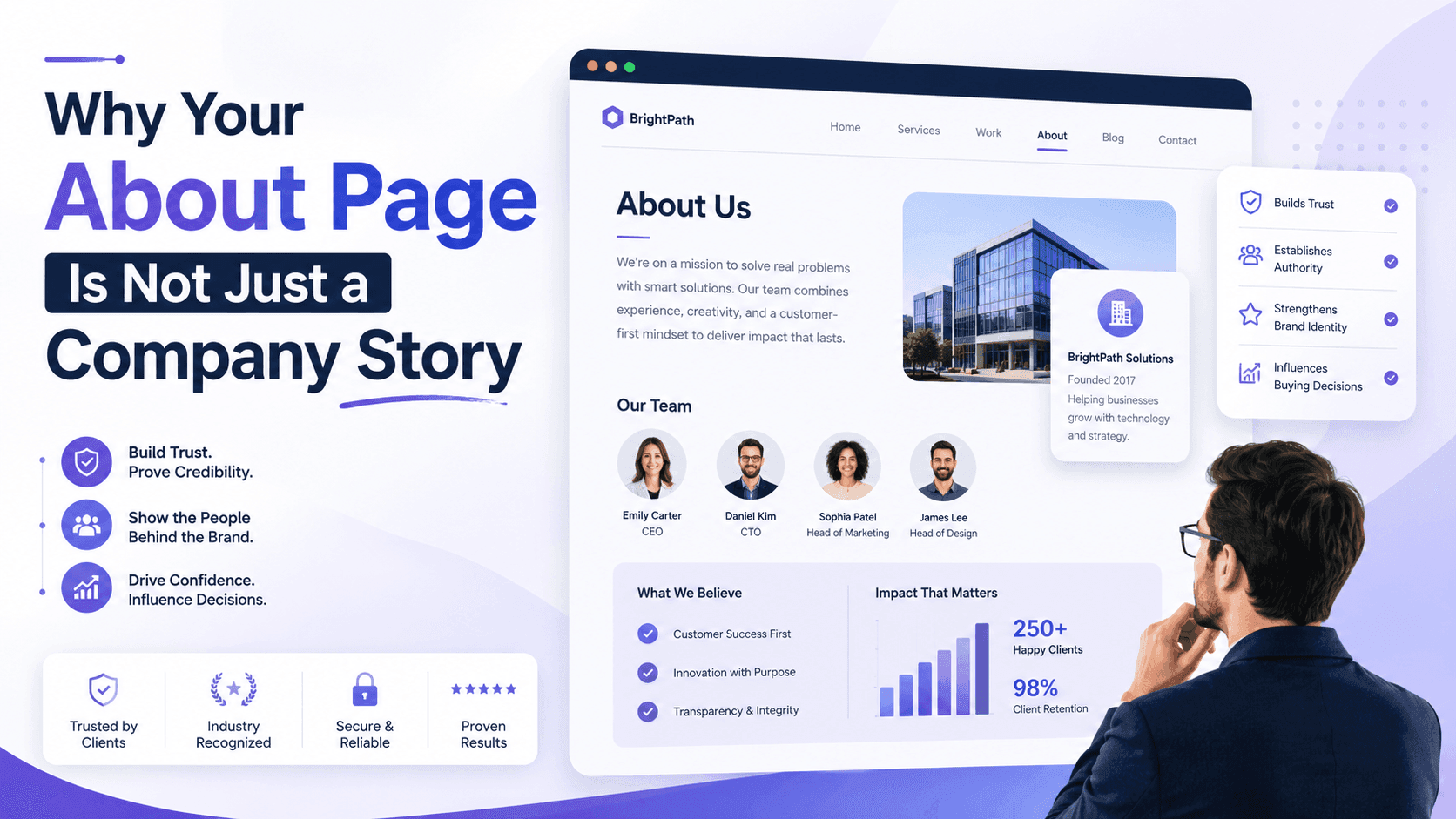
A visitor may find your company through a service page, blog post, ad, or search result. Yet before contacting you, they may open the About page.
They are not always looking for a dramatic founder story. They may be checking whether the business is real, experienced, and suitable for their needs.
That makes the page more than a space for company history. It can influence trust, hiring, partnerships, media interest, and sales.
Good about page optimization helps people understand who you are, what you do, why your work matters, and what they should do next. It turns a basic company introduction into a useful decision-making page.
Why People Visit an About Page Before Making a Decision
Most visitors do not begin their website visit on the About page. They usually arrive there after another page has created interest.
At that point, their questions change. They are no longer asking only what the company offers. They also want to know who stands behind those promises.
They Want to Confirm That the Business Is Real
Visitors often look for details that confirm the company exists beyond a logo and a contact form.
They may check:
The company name
Team or leadership information
Business location
Contact details
Years of experience
Professional memberships
Recognizable projects or customers
This matters even more when the purchase involves a large budget, sensitive information, or a long-term commitment.
Missing details do not always mean a company is unreliable. However, they can make visitors pause. Online, a pause can quickly turn into a return to the search results.
They Want to Judge Whether the Company Fits Their Needs
Ready to start your project?
Talk with our team and get a clear plan, timeline, and estimate.
Get a Free ConsultationAn About page can help visitors decide whether the business is the right type of provider.
A startup may want a flexible team that can move quickly. A larger company may care more about security processes, industry experience, or team capacity.
The page should make the company’s position clear. It can explain who the business serves, where it operates, what industries it understands, and how it usually works with clients.
This helps the right people continue while allowing poor-fit visitors to rule themselves out.
They Want to See the People Behind the Claims
People often trust a business more when they can see who is responsible for the work.
Team information should do more than display names and job titles. A useful profile can explain the person’s role, experience, area of responsibility, and contribution to client results.
A small personal detail can make the profile warmer. Still, the page does not need to reveal everyone’s favorite pizza topping. The visitor came for confidence, not a team-wide food survey.
They Want to Know What to Do Next
A strong About page should not end with a polite goodbye.
Once visitors understand the company, they should have a clear route forward. That may include viewing services, reading a case study, meeting the team, checking open roles, or contacting the business.
The next step should match the visitor’s likely purpose. This makes the page useful instead of decorative.
Connect the Company Story to the Customer’s Decision
A company story can build interest, but only when it supports the visitor’s decision.
The goal is not to document every office move, logo change, or team lunch. The story should explain how the business became qualified to solve the problems it handles today.
Tell the Parts of the Story That Explain the Business
Choose milestones that reveal something meaningful.
You may explain why the company was founded, what problem it noticed, how the offer changed, which skills it developed, and what lessons shaped its current process.
A useful story moves from origin to present value.
For example, a software company may have started after its founders saw small businesses struggle with complex tools. That origin matters because it explains the company’s focus on simple systems.
The story should answer a practical question: how did this business become prepared to help its current customers?
Turn Values Into Observable Business Practices
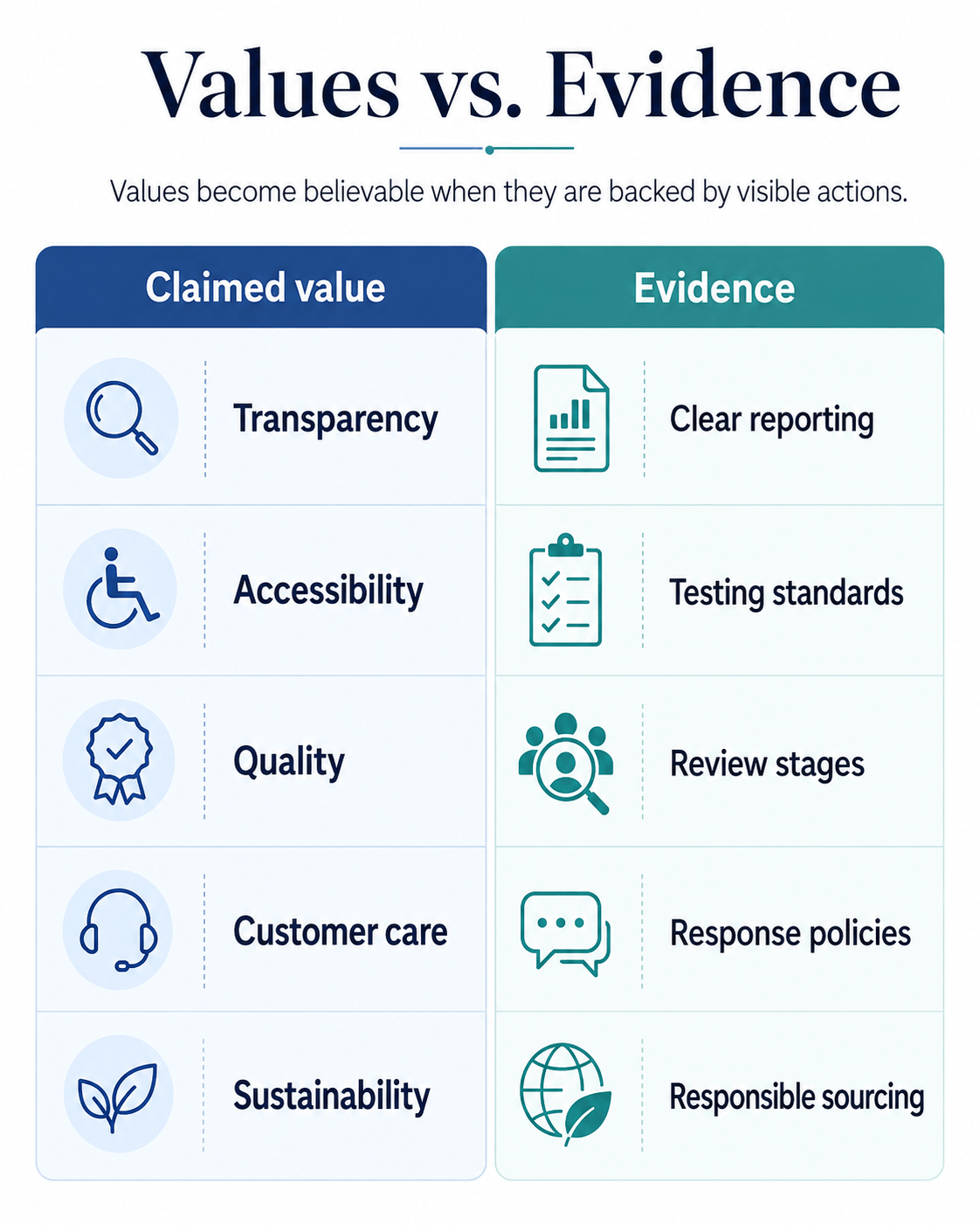
Many About pages list values such as integrity, quality, teamwork, and innovation. These words sound pleasant, but they are easy to claim.
Values become believable when the page connects them with actions.
For example:
Transparency may appear through clear reporting.
Accessibility may appear through testing standards.
Quality may appear through review stages.
Customer care may appear through response policies.
Sustainability may appear through sourcing choices.
This is a key part of about page optimization that Trifleck takes care of because it replaces broad claims with evidence. A row of shiny value icons is not proof, even if the icons look very sincere.
Include the Company Information People Need to Verify
Visitors should not have to search several pages to understand the basic identity of the company.
The About page should provide enough information to explain what the business does, who it serves, and why its claims deserve attention.
Explain What the Company Does in Plain Language
Start with a clear business description.
Explain the main product or service, the people it serves, the problem it solves, and the market or location it covers.
Avoid vague lines such as “We create meaningful solutions for a changing world.” That could describe a software company, a furniture brand, or a group selling unusually ambitious notebooks.
Plain language makes the page easier for visitors and search systems to understand.
Identify the Customers and Markets You Serve
Visitors should be able to tell whether the company works with businesses like theirs.
Mention relevant customer types, industries, business sizes, locations, or use cases. Keep the information specific enough to be useful, but do not turn the page into a complete service catalogue.
Links can lead to deeper industry or service pages.
This also improves lead quality. A company that mainly serves healthcare organizations should say so rather than attracting every possible inquiry.
Present Leadership and Team Roles Clearly
The right team format depends on the size of the business.
A small company may include several complete team profiles. A larger organization may introduce founders, executives, department heads, or customer-facing specialists and then link to a separate team page.
Each profile should explain why the person matters to the visitor.
Relevant qualifications, experience, and responsibilities are more useful than long biographies. The About page is not a résumé warehouse.
Support Expertise With Relevant Proof
Claims are stronger when visitors can verify them.
Useful proof may include:
Certifications
Licenses
Awards
Professional memberships
Client results
Research
Publications
Security standards
Years of relevant experience
Choose evidence that relates to the company’s actual work.
An award from an unknown source may look impressive at first, but it can also raise questions. Proof should reduce doubt, not create a new mystery.
Make Ownership, Location, and Contact Details Clear
Some companies operate under several brands, legal names, or regional offices. That can confuse visitors.
Explain the trading name, parent company, headquarters, service area, and contact channels when relevant. Regulated businesses may also need to display licenses or registration details.
These facts support about page optimization by helping people confirm that website information matches the wider business.
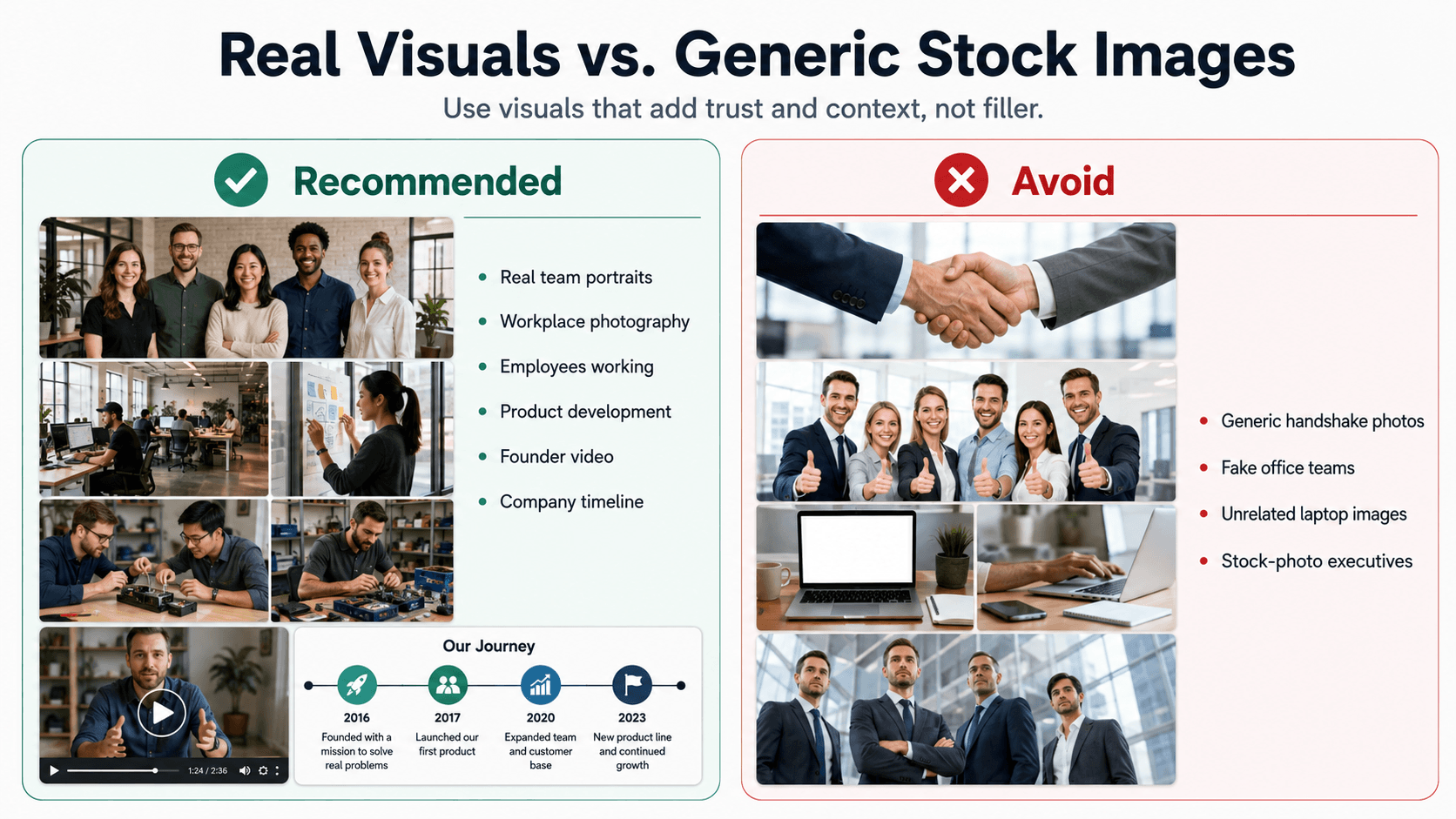
Use Visuals to Demonstrate Authenticity, Not Fill Space
Visuals should provide context. They should help visitors understand the team, environment, work, or scale of the business.
They should not exist only because the website template came with three empty picture boxes.
Choose Images and Videos That Add Verifiable Context
Useful visuals may include:
Real team portraits
Workplace photos
Employees doing relevant work
Product development images
Customer-facing environments
Short founder videos
A visual company timeline
Captions can identify names, roles, dates, or locations. This makes images more informative.
Photos should also be compressed and properly cropped for mobile screens. Videos need captions or transcripts. Alt text should describe meaningful images for people who cannot see them.
Avoid presenting stock-photo models as the team. Visitors may recognize the same “executive” from a dentist’s website, a bank ad, and a cybersecurity homepage.
Make the About Page Easier to Understand in Search
The About page does not need to compete with every commercial service page.
Its main search role is usually to help people find and understand the company, leadership, history, location, and identity. This part of about page optimization makes brand information clearer without forcing the page to target unrelated searches.
Optimize the Page for Brand and Company Questions
Use the company name naturally in the title tag, H1, opening copy, and relevant image descriptions.
The page may also answer searches related to:
The founder
Company ownership
Business location
Company history
Team members
Mission and values
Brand reputation
The URL should be simple, such as /about or /about-us.
Effective about page optimization focuses on clear brand information. It does not force the main service keyword into every paragraph or employee profile.
Build Clear Connections With Related Website Pages
The About page should connect company claims with supporting evidence.
Link to useful pages such as:
Services
Products
Case studies
Leadership profiles
Careers
Contact information
Certifications
Policies
Press resources
Related pages should also link back when company identity or expertise matters.
These connections help visitors move from broad claims to detailed proof. They also make the website structure easier to understand.
Add Suitable Organization Information and Structured Data
Organization structured data can help search systems interpret company details.
Relevant information may include the company name, URL, logo, address, phone number, founding date, founders, and official social profiles.
The information in the markup should match what visitors can see on the website.
Structured data supports about page optimization, but it cannot rescue unclear writing or false claims. Code can label the facts. It cannot invent credibility.
Ready to start your project?
Talk with our team and get a clear plan, timeline, and estimate.
Get a Free Consultation
Turn Company Trust Into a Useful Next Step
Different visitors may open the About page for different reasons.
Some are potential customers. Others may be job seekers, partners, suppliers, journalists, or researchers.
The page should guide each important group without turning into a wall of competing buttons.
Guide Potential Customers Toward Relevant Services
Potential customers may want to confirm the company before exploring the offer in more detail.
Useful links can include:
Explore our services
View our recent work
Read a case study
Request a consultation
Discuss your project
The CTA should follow naturally from the surrounding section. A sudden “Buy Now” button after a paragraph about company values can feel a little impatient.
Give Job Seekers a Clear Route to Careers
Job seekers often check the About page before reading open positions.
Link them to information about vacancies, culture, benefits, the hiring process, internships, or employee stories.
If recruitment content becomes detailed, move it to a separate careers page. The About page should introduce the workplace, not carry the entire employee handbook.
Help Partners and Suppliers Find Relevant Information
Partners and suppliers may need different contact routes from customers.
Provide clear paths for technology partners, affiliates, vendors, distributors, or community organizations.
Sending every inquiry to the same form creates extra work. It also increases the chance that an important message lands with the wrong team.
Support Journalists and Industry Researchers
Some companies receive press, research, or speaking requests.
A short media section can link to leadership biographies, company facts, press contacts, announcements, brand assets, or high-resolution images.
Businesses with frequent media activity may need a dedicated press page. Others can keep this section brief.
Measure How Visitors Use the Page
Traffic alone does not reveal whether the About page is useful.
Track actions such as service-page clicks, case-study visits, contact clicks, career-page visits, and form submissions.
Also review where visitors came from and which page they open next.
This data shows whether the page creates confidence or becomes an exit point. About page optimization should support meaningful movement, not simply longer page views.
Update the Page When the Company Changes
An outdated About page can weaken trust.
Review it when the company changes leadership, ownership, branding, services, office location, certifications, markets, or contact details.
Team photos and employee profiles also need updates.
A periodic review is useful even when nothing major has happened. The page should describe the company that exists today, not the version that had four employees and one office plant five years ago.
Final Thoughts
An About page is not a storage area for company history.
It should help visitors understand the business, verify important facts, meet the people responsible, evaluate expertise, and choose a useful next step.
Strong about page optimization combines identity, customer relevance, proof, search clarity, visuals, and conversion paths.
A good story can attract attention. Clear information and credible evidence turn that attention into trust.