
If you are building your first product, you already know how challenging it is to balance ambition and budget. Most founders reach a point where they have a clear idea, some early feedback, maybe even initial investor interest, but they still struggle to understand what it will actually cost to build an MVP (Minimum Viable Product). That is the moment this app cost guide for startups becomes practical. The goal is not to overwhelm you with numbers, but to help you see how the decisions you make shape the total investment.
Startups often expect an MVP to be cheaper than it actually is, not because developers overcharge, but because founders underestimate what goes into creating even the most basic version of an app. An MVP still needs planning, structure, design, clear user flows, backend logic, integrations, and testing. When you break down the work piece by piece, the cost begins to make more sense.
This guide walks you through the parts of an MVP that influence pricing, why some projects are more expensive than others, and how you can make smarter decisions that protect your budget.
Why MVP Cost Matters More Today
Over the past few years, startup funding has tightened. Investors now ask more questions, expect clearer reasoning, and want to see concrete proof before committing capital. At the same time, user expectations have increased. Even early adopters expect apps to work smoothly, load quickly, and feel intuitive.
The combination of these two realities means founders cannot afford to guess their MVP budget. A well-planned MVP allows you to reach the market faster, learn from real users, and adjust direction before spending more money. A poorly planned MVP often creates setbacks that are expensive to fix.
When you understand which parts of the product drive cost, you make better choices from the beginning, and your MVP becomes a stepping stone rather than a financial trap. This is exactly what a real app cost guide for startups should help with.
Common Misunderstandings Founders Have About MVP Pricing
Before we get into details, it helps to address a few misconceptions that come up in almost every consulting conversation.
Misunderstanding 1: “An MVP is just a simple version of the final product.”
This is only partly true. It is simple in scope, not simple in execution. Even limited features need to be designed, built, connected to a backend, tested, and secured.
Misunderstanding 2: “MVP means cheap.”
The MVP is the foundation of your entire product. If the foundation is weak, you pay more later to rebuild or fix what should have been done right the first time.
Misunderstanding 3: “Developers charge more than they should.”
Most of the cost comes from time. Planning takes time. Building takes time. Testing takes time. The more features you add, the longer it takes.
Misunderstanding 4: “We can add more features later, so let’s include everything now.”
This thinking expands the scope before the product even reaches the market. It is one of the fastest ways to exceed your budget.
A thoughtful app cost guide for startups removes these assumptions and replaces them with a clear understanding of how MVP decisions affect your finances.
What Actually Drives MVP App Cost
When a founder asks, “How much will this MVP cost?”, the real answer depends on several important decisions. These decisions appear simple at first, but they shape the entire project.
Below is a breakdown of the factors that influence MVP pricing.
1. The Problem You Are Solving
Every MVP begins with a specific problem. The clearer this problem is, the easier it becomes to identify the core features needed to solve it. When founders struggle to define the problem, they add too many features. More features mean more design, more backend logic, more testing, and more cost.
Clarity reduces spending. Confusion increases it.
2. Core Features and What “Core” Really Means
Core features are the minimum functions needed for users to try your product and give feedback. Many founders mistakenly add extra features because they “might be useful.” These additions increase cost without helping validation.
A simple way to define core features is:
- What action must users complete to test the concept
- Which features directly support that action
- Which features help measure behavior or collect data
Everything else should wait until after the MVP launch.
A realistic app cost guide for startups always starts with strict prioritization.
3. User Experience and Interface Decisions
An MVP does not need premium design, but it does need a clear and easy experience. Even simple apps require thoughtful decisions about:
- Screen layout
- User flow
- Button placement
- Form structure
- Navigation
Good UX speeds up development because developers know exactly what to build. Poor UX slows everything down because it creates redesigns, misunderstandings, and user confusion.
Design affects cost more than founders expect. Clean UX saves money in development and testing. Messy UX adds both time and rework.
4. Platform Choice: iOS, Android, or Both
Choosing how your app is built affects your cost significantly.
Building separately for iOS and Android
This doubles certain work, which increases the budget. Native development offers high performance, but it is usually not necessary for MVPs.
Cross-platform development
Using tools like Flutter or React Native allows one codebase to run on both platforms. This reduces time and cost and is the most common choice for early-stage MVPs.
Web first MVP
A browser-based MVP is often the cheapest option and a great choice for early validation. Many founders start here before investing in mobile apps.
Your platform choice shapes the full direction of your app cost guide for startups.
5. Backend Requirements
The backend is the engine of your app. Even MVPs need a functional backend that handles:
- Login and user accounts
- Data storage
- Basic logic
- Notifications
- Admin controls
- API connections
A simple backend is affordable. A scalable backend designed for growth requires more work. Some apps also need real-time data, role-based permissions, analytics, or integrations, which raise the cost.
Backend decisions influence the budget more than any other technical component.
6. Third-Party Tools and Integrations
Integrations are helpful because they save development time, but they also add cost. Examples include:
- Payment gateways
- Messaging platforms
- Cloud storage tools
- Analytics services
- Authentication providers
Some integrations require monthly fees, which add to your ongoing expenses. A good app cost guide for startups includes both development cost and subscription cost.
7. Testing and Quality Checks
Testing is a crucial part of the process. A small bug can cause users to lose trust. An unstable MVP creates a bad first impression and can hurt early growth.
Testing usually includes:
- Functional testing
- Device testing
- Usability checks
- Regression testing after changes
Cutting corners here may seem like a way to save money, but it usually costs more later when issues appear after launch.
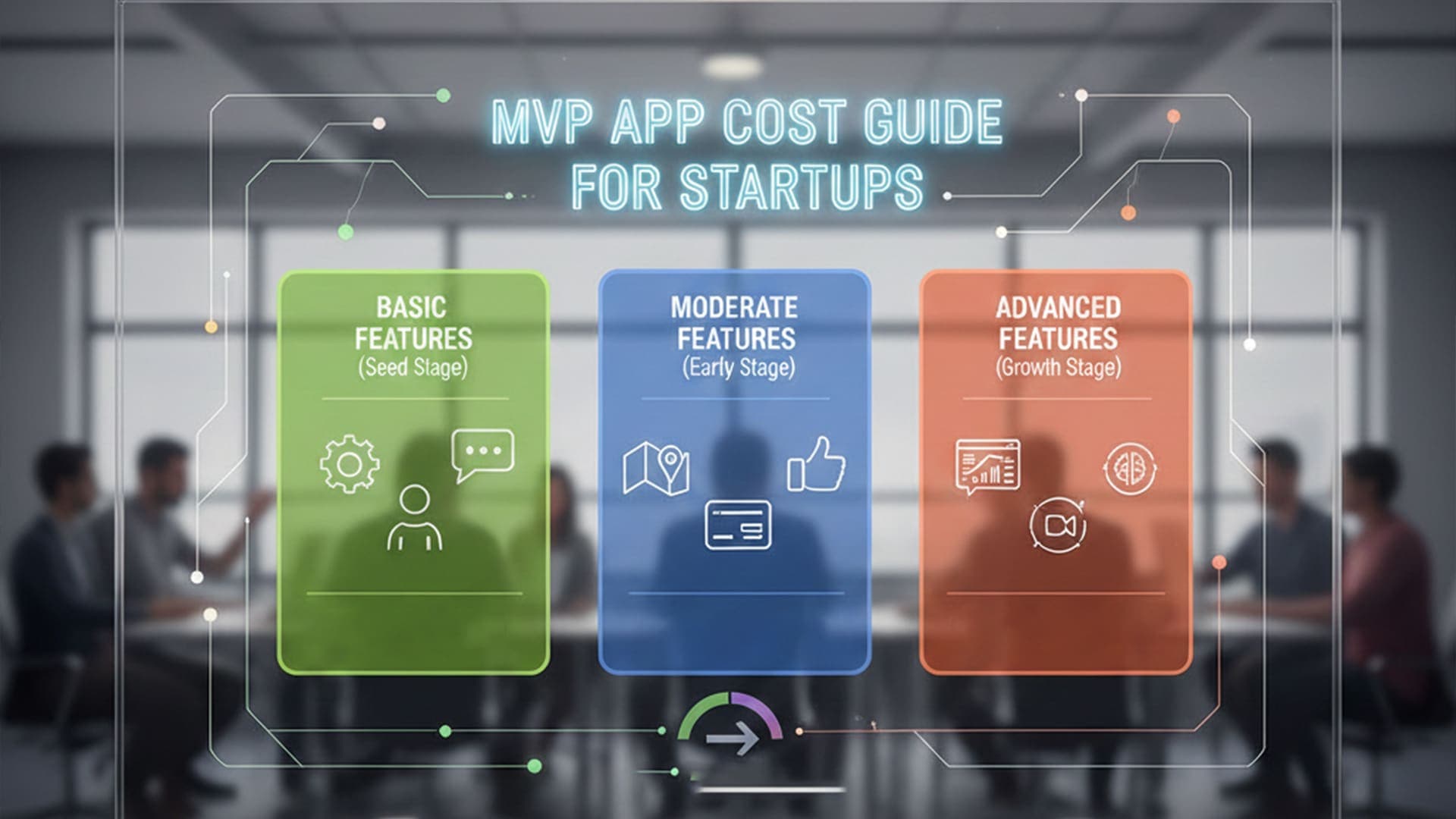
Now that you understand what influences MVP pricing, the next question founders usually ask is: “What should we expect to pay?” The answer depends on how you apply the factors above, but real-world ranges help set expectations.
Realistic MVP Cost Ranges for Startups
These ranges reflect typical pricing when working with professional developers or agencies, not low-budget freelancers or unclear offshore setups. They are based on what founders usually encounter when building practical MVPs.
Simple MVP
These apps have a small set of features and minimal backend requirements.
Examples: simple content apps, basic utility tools, single-function platforms.
Typical range: 15,000 to 35,000 USD.
Moderate MVP
More features, user accounts, payment integration, dashboards, or simple automation.
Examples: booking platforms, marketplaces, subscription-based apps.
Typical range: 35,000 to 70,000 USD.
Complex MVP
Advanced logic, real-time features, AI-assisted components, or multiple user roles.
Examples: social products, fintech tools, learning platforms, analytics-based apps.
Typical range: 70,000 to 150,000 USD or more, depending on scope.
Remember, these figures are not arbitrary. They reflect the number of people involved, the time required, the planning effort, the backend setup, and the quality level expected from a product that goes into the market.
A strong app cost guide for startups helps founders understand these ranges before they begin planning so they can avoid unexpected pressure later.
Hidden Costs Founders Often Overlook
There are expenses that do not appear on the first proposal but impact the overall investment. You should plan for them early so they do not affect your timeline or create financial strain.
1. Third-party subscriptions
Payments, maps, email services, analytics tools, and messaging providers. These often charge monthly based on usage.
2. Cloud hosting
As your app grows, your server usage goes up. This increases monthly hosting fees.
3. App Store and Play Store fees
Annual developer accounts, review delays, and resubmissions.
4. Maintenance after launch
Bug fixes, small improvements, and compatibility updates.
5. Content creation
Some apps require written content, images, icons, or branding assets.
6. Analytics setup
Custom event tracking or dashboards often require additional configuration.
A realistic app cost guide for startups always includes these items, so founders do not underestimate the true investment.
How to Plan an MVP Budget That Works in the Real World
A good budget is not about predicting exact numbers. It is about giving yourself enough room to build something functional without running out of resources. Below is a practical approach used in consulting sessions with early-stage teams.
1. Start with your core assumption.
Identify the single thing you want to prove. Everything else revolves around this.
2. Define the smallest set of features that support this assumption.
If a feature does not contribute to validation, save it for later.
3. Choose a development approach that matches your stage.
Many early products do not need native apps. Cross-platform or web-first MVPs are often enough.
4. Build a buffer.
Set aside 10 to 15 percent for changes, missing requirements, or new discoveries during development.
5. Protect the timeline.
Long delays increase cost. Clear decision-making helps avoid this.
6. Choose your team carefully.
Good communication and structured planning reduce rework and save money.
This planning method turns your MVP from a vague idea into a manageable financial project, which is the purpose of any good app cost guide for startups.
If you already have an idea for your MVP and want a team that can build it with a clear plan and predictable costs, Trifleck can help. We work with startups to shape the scope, define the essentials, and develop the first version of the product in a way that supports real testing and future growth.
Mistakes That Increase MVP Cost
Founders do not usually overspend because development is expensive. They overspend because the project is mismanaged. Here are common mistakes that raise costs unnecessarily.
Adding features mid-project.
Scope changes are the most expensive issue in MVP development. They affect design, backend logic, and testing.
Skipping the discovery phase.
Without planning, requirements remain unclear and teams make incorrect assumptions.
Assuming design is optional.
Poor design increases development time because the team has to redo unclear screens.
Ignoring feedback from early testers.
Many startups continue building without learning from real user behavior.
Hiring based on low rates instead of proven experience.
This often leads to technical debt that costs significantly more to repair later.
When founders avoid these mistakes, their MVP becomes more predictable and affordable.
How Startups Can Reduce MVP Cost Without Losing Quality
Cutting costs is not about removing value. It is about choosing smarter pathways.
1. Choose cross-platform development
A single codebase for iOS and Android reduces time and cost.
2. Use existing tools for common features
Payments, authentication, notifications, and analytics do not need to be built from scratch.
3. Delay advanced features
Focus on the actions that let users test the core experience.
4. Start with a lighter backend
You do not need full scalability on day one. You can strengthen the architecture once traction improves.
5. Evaluate design realistically
Clean, simple design works well for an MVP and saves money.
6. Work with a team that documents clearly
Clear communication reduces rework and makes the project smoother.
A strong app cost guide for startups shows you where you can reduce cost without harming the user experience or the long-term roadmap.
Conclusion:
What Startups Should Remember
An MVP is not just a technical build. It is a strategic first step that shapes the direction of your entire product. Understanding the factors that influence cost helps you plan better, reduce risk, and launch with confidence. A clear app cost guide for startups gives founders the clarity they need to set realistic expectations, avoid unnecessary spending, and make decisions that support long-term success.
By understanding your core features, choosing the right platform, planning your backend wisely, and working with a structured development partner, you can build an MVP that serves both your users and your business. The more informed your decisions are, the smoother your development process becomes.
If you ever want your idea reviewed or need help planning your MVP budget, Trifleck can support you with strategic guidance and clear, grounded advice from real project experience.