There’s a certain pattern that shows up every time a new technology starts reshaping work. First comes the excitement. Then the panic. Then the predictions that sound like they were written in all caps.
Artificial intelligence has followed that exact cycle.
For the last couple of years, the dominant narrative has been simple: AI is coming for white-collar jobs. Not slowly, but in waves. Entire entry-level roles disappearing. Corporate structures collapsing. A kind of quiet “automation shock” spreading through offices.
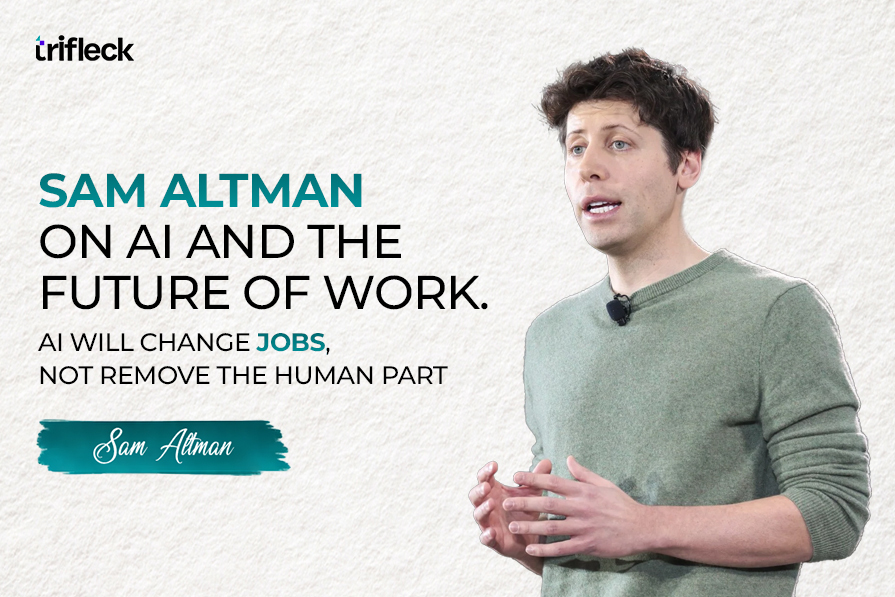
But recent comments from Sam Altman suggest something more complicated is actually happening on the ground.
Speaking at a business conference hosted by Commonwealth Bank of Australia, Altman admitted something that is rare in the tech world. He said his early assumptions about the speed of job disruption were, at least for now, off.
Not wrong about the direction. Wrong about the timing.
That distinction matters more than it sounds.
When OpenAI released ChatGPT, the assumption across much of the industry was that knowledge work would begin shrinking almost immediately. Writing, analysis, coordination, support tasks, even junior roles were expected to compress quickly under automation pressure.
But that widespread displacement hasn’t shown up in the way many expected.
Instead, what has emerged is something slower and more layered. AI has entered workflows, but it hasn’t fully replaced the human structure around those workflows. It has changed how work is done, not removed the need for the people doing it.
Altman’s reflection is interesting because it shifts the conversation away from fear and into something more practical.
He pointed out something deceptively simple. Even in environments where AI can technically handle tasks like writing responses or drafting communication, people still prefer human interaction. He even shared his own experience of letting AI respond to messages before eventually pulling back.
Not because it didn’t work.
But because it didn’t feel right.
That detail is important, and most discussions around automation miss it entirely. Work is not only execution. It is also trust, tone, judgment, and context. A large part of business communication still depends on human presence, even when tools are available to remove it.
This is where the early “replacement narrative” starts to break down.
Across industries, including finance, retail, logistics, and technology, companies like Amazon, HSBC, and Standard Chartered are actively integrating AI into operations. But what they are discovering is not full replacement. It is redistribution of effort.
Repetitive work is being automated. Decision-heavy work is not disappearing. It is shifting upward.
And that creates a very different kind of workforce question.
Not “What jobs will vanish?”
But “What parts of work remain fundamentally human?”
Altman’s answer, indirectly, is interaction.
There is still a “human layer” in most jobs that AI does not easily replicate. You can automate a process, but you cannot fully automate accountability, trust, or the subtle friction of real communication between people making decisions under uncertainty.
That is why the workplace is not collapsing under automation. It is reorganizing around it.
Entry-level roles are evolving rather than disappearing. Senior roles are absorbing new responsibilities. Teams are becoming smaller in some areas and more tool-dependent in others. The shape is changing, but the structure is still there.
For founders and product teams, this matters more than any prediction about timelines.
Because it shifts the real question from fear-based planning to design thinking.
How do we build systems where AI handles repetition, but humans stay in control of meaning, judgment, and direction?
At Trifleck, this is the shift we see most often in real product work. The companies that struggle are not the ones ignoring AI. They are the ones trying to implement it without rethinking workflows, user behavior, and decision layers inside their systems.
The ones adapting well are not replacing people. They are redesigning roles.
Altman’s broader point lands quietly but clearly: the future of work is not a clean replacement story. It is a messy integration story. One where AI becomes infrastructure, not identity.
And in that kind of future, the companies that win will not be the ones that automate the fastest.
They will be the ones that understand where not to automate at all.