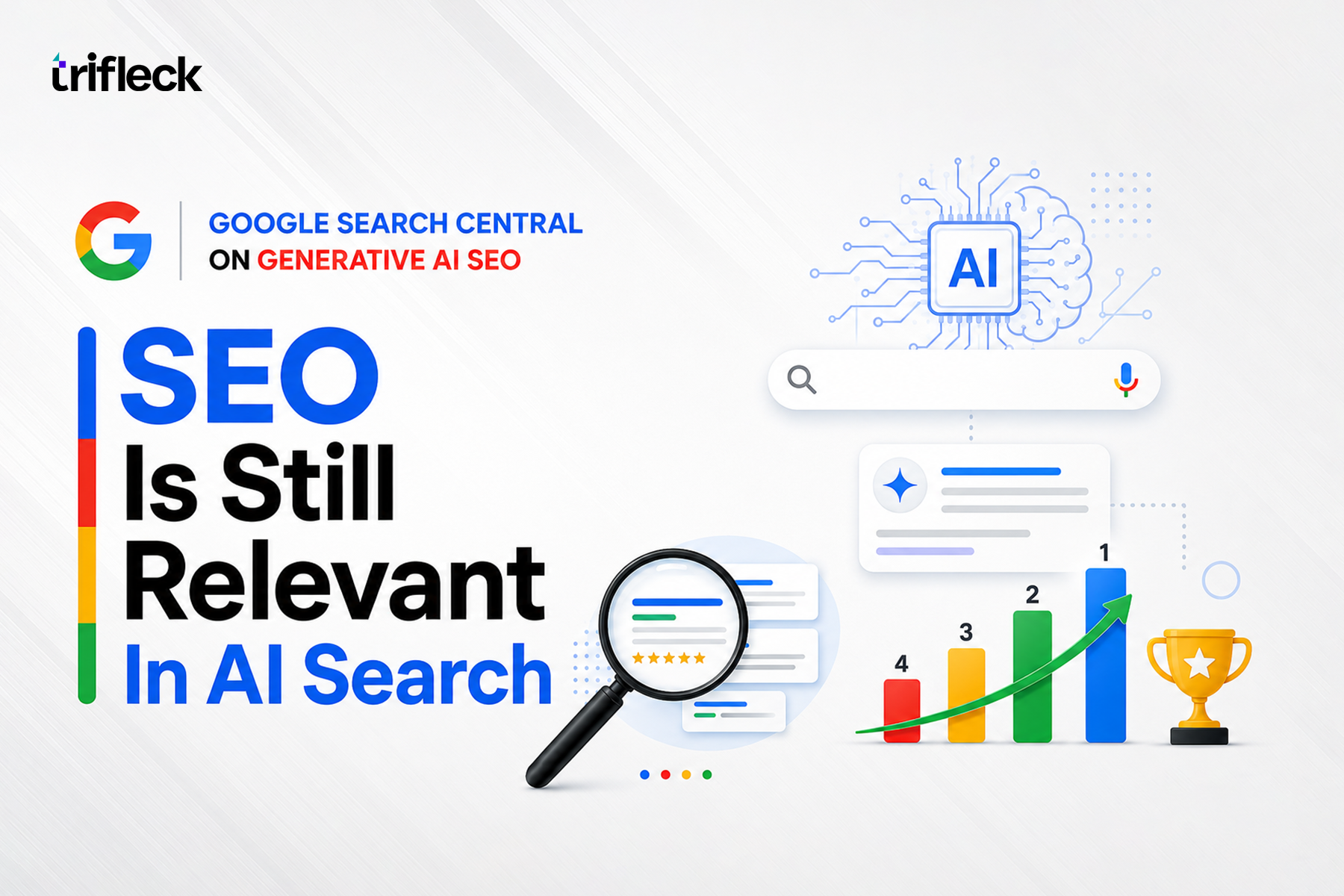
Generative AI is changing how people search, compare options, and make decisions. But according to Google Search Central, the rise of AI Overviews, AI Mode, and other generative experiences does not mean traditional SEO has become irrelevant.
Google’s message is the opposite.
Generative search still depends on Google’s ranking, indexing, and quality systems. AI-powered answers rely on information already discovered, evaluated, and retrieved from the web.
For marketers and business owners, the goal is not to abandon SEO. The real task is to strengthen the fundamentals that have always created lasting visibility.
Google says its AI features use systems such as retrieval-augmented generation and query fan-out. These systems retrieve relevant pages, explore related questions, and use current information to build a useful response.
AI answers therefore depend on strong source material. A website must be accessible, understandable, and credible enough to be retrieved.
The essentials remain clear:
Answer Engine Optimization and Generative Engine Optimization are increasingly presented as new disciplines built specifically for AI search.
Google takes a more grounded position: optimizing for generative search is still part of optimizing for Search.
New terminology may describe changing formats, but it does not replace solid SEO. There is no shortcut that guarantees inclusion in an AI-generated answer.
The same core qualities still matter:
One of the strongest themes in Google’s guidance is the importance of non-commodity content.
Generic content is easy to produce and equally easy to replace. Articles built around recycled tips, predictable lists, and summaries may be technically correct, but they give readers little reason to stay.
Generative AI has made this weakness more visible. When a machine can reproduce the same article within seconds, that content offers little defensible value.
Stronger content usually includes:
Google is trying to connect users with content worth visiting, not merely pages containing familiar information.
Useful content cannot perform if Google cannot properly access or process it.
Website owners should improve technical clarity instead of searching for special AI-only markup. Pages should load well, function across devices, and make the main content easy to identify.
Important priorities include:
Structured data remains useful for traditional rich results, but Google says there is no unique schema required for generative AI search.
The growth of generative search has created tactics that sound innovative but are not supported by Google’s official guidance.
Website owners do not need to:
Google can understand synonyms, context, and several related ideas on one page. There is also no perfect article length. Content should be as long or as short as necessary to satisfy the reader.
Creating a separate page for every possible query is not only unnecessary; when done primarily to influence rankings, it can move into scaled content abuse.
The best response to generative search is not panic. It is discipline.
Marketers should prioritize:
These agentic experiences are also worth watching. AI systems may increasingly compare products, inspect website information, interpret page structures, or complete actions on behalf of users.
Businesses do not need to rebuild everything immediately, but they should understand that websites may soon serve both human visitors and task-oriented AI agents.
The larger lesson is clear: generative AI does not eliminate SEO. It raises the standard.
Brands relying on recycled information, mass-produced pages, and technical tricks may struggle. Brands publishing useful, original, trustworthy content will remain valuable whether users arrive through a traditional search result, an AI Overview, or an emerging AI agent.
Search is changing, but the principle behind sustainable visibility is not.
Create something worth finding.