

Restaurant App Development
Apps designed for direct restaurant operations where speed and clarity matter. Strong restaurant app development ensures menu access, order flow, and checkout work without delays.
Food delivery businesses depend heavily on digital systems, but many struggle when their apps fail under real usage conditions. At Trifleck, our food delivery app development builds systems that support how users browse menus, place orders, track deliveries, and reorder without friction. The focus stays on performance, operational flow, and system reliability instead of surface-level features.
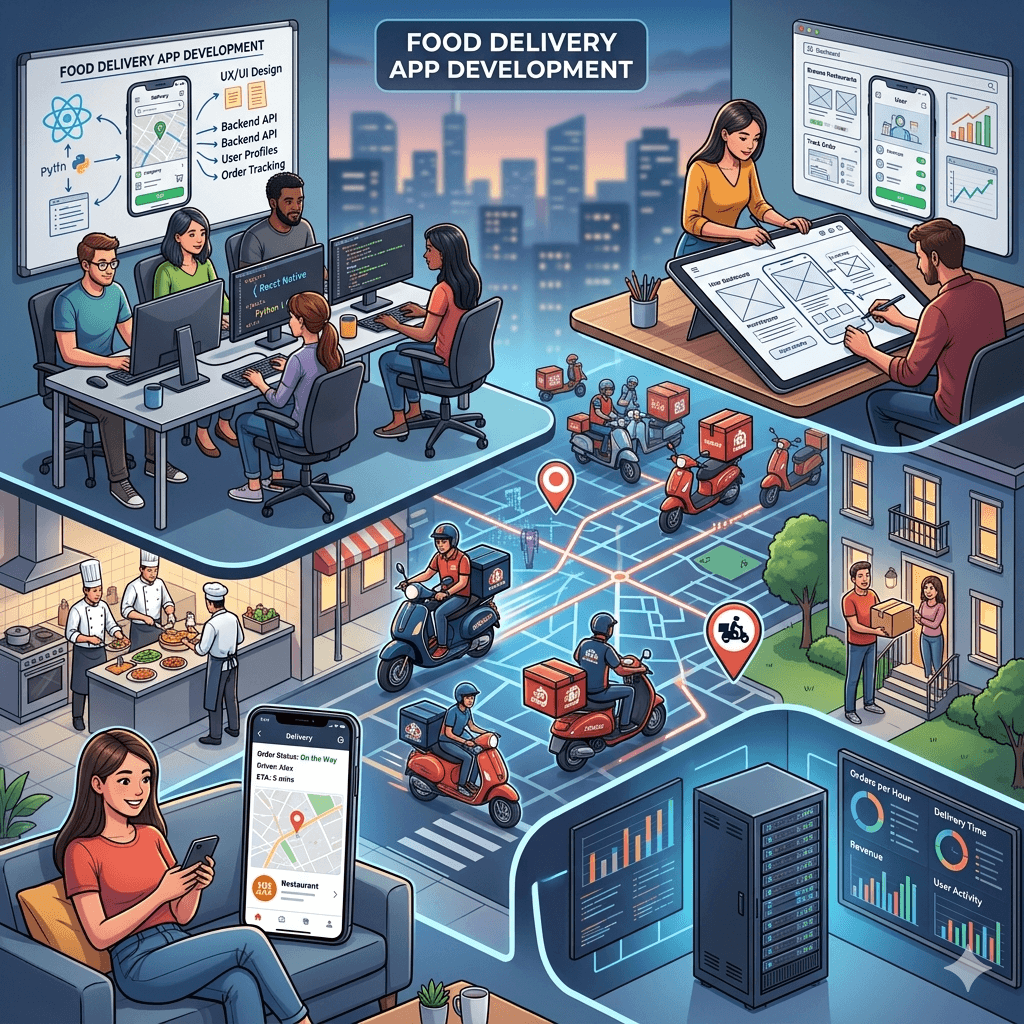
Food delivery apps often perform well in controlled environments. The problems start when real users interact with them.
A user will not tolerate slow menu loading. A customer will abandon an order if checkout feels confusing. Restaurants cannot manage incoming orders if the system delays updates. Drivers cannot deliver efficiently without accurate routing.
The issue is rarely the idea. It is the execution.
Most online food ordering apps miss three critical layers:
This is why many businesses return for food delivery app development after their initial product fails to scale.
Every food delivery platform operates differently. A single restaurant app behaves differently from a marketplace or a hybrid delivery system.
Apps designed for direct restaurant operations where speed and clarity matter. Strong restaurant app development ensures menu access, order flow, and checkout work without delays.
Marketplace systems support multiple vendors within one platform. These require structured onboarding, commission handling, and stable order routing across vendors.
Cloud kitchens operate without physical storefronts and depend entirely on digital systems. Effective cloud kitchen app development focuses on order volume handling, kitchen coordination, and delivery synchronization.
Delivery platforms are expanding beyond food into essentials. Grocery delivery app development requires inventory synchronization, fast browsing, and reliable order fulfillment systems.
Mobile-first platforms require speed and simplicity. Well-built food ordering mobile apps focus on fast interactions, clear navigation, and minimal friction during checkout.
Beyond customer apps, businesses need connected systems. Food tech app solutions include backend infrastructure, admin systems, and integrations that keep operations aligned.
Performance should support growth, not limit it. Build apps that handle real-time orders, delivery coordination, and user behavior without friction.
Features are easy to list. The real challenge is making sure they are used.
That depends on how they are implemented.
Strong food delivery app development is not built by adding more features. It is built by reducing friction at every step.
Users do not analyze interfaces. They react to them.
Confusing navigation, cluttered screens, or delayed responses create hesitation. That hesitation leads to abandoned orders.
Food delivery UI UX design focuses on:
Good design does not draw attention. It removes resistance.
Most delivery app issues do not come from development. They come from unclear planning.
Our process is structured to avoid that.
We map how users place orders, how restaurants process them, and how deliveries are completed. In food delivery app development, this ensures systems match real workflows from the beginning.
Interfaces are designed to reduce effort and guide users naturally through ordering and tracking.
We plan how your app connects with payment systems, delivery tracking tools, and backend platforms like restaurant management software.
The system is built using scalable technologies like React and modern backend frameworks to support growth and performance.
We test apps under real conditions, including peak-hour traffic and high order loads.
After launch, we monitor performance and refine the system to improve speed, stability, and user experience.
Food delivery platforms evolve quickly. Systems must support continuous demand.
Food delivery apps depend on connected systems.
We integrate with:
This ensures orders, tracking, and operations stay consistent across the entire system.
Food delivery businesses need systems that perform consistently, not just look complete.
Many companies offer food delivery app development, but not all focus on how systems behave under real pressure.
Here are some outcomes achieved:
Improved order completion rates by up to 34%
Reduced checkout drop-offs by 40%
Built delivery systems capable of handling high numbers of users during peak hours
Improved app response time by up to 50% for smoother user experience
If you are planning food delivery app development, the focus should not be on adding more features. It should be on reducing friction, improving system flow, and ensuring performance under pressure.
Menu updates should be managed through version control at the backend level. This allows restaurants to modify availability or pricing without affecting orders already in progress. A well-structured food delivery app development system separates active orders from live menu data to avoid conflicts.
Order mismatches usually happen when systems are not synced in real time. The solution is to use event-based updates where every action, like order confirmation or pickup, triggers a system-wide update instantly. This ensures all parties see the same order status at the same time.
ETAs should not rely only on distance. They need to factor in kitchen prep time, real-time traffic data, driver availability, and historical delivery patterns. Strong food delivery app development combines these variables to provide realistic delivery timelines instead of static estimates.
Multi-vendor systems require a modular backend where each restaurant operates independently but connects to a shared order and payment system. This setup allows scaling vendors without slowing down performance or creating data conflicts.
The system needs load balancing, scalable cloud infrastructure, and optimized database queries. Instead of processing everything on a single server, traffic is distributed across multiple layers. In food delivery app development, this ensures stability even during lunch or dinner rush spikes.
Cancellations should follow defined workflows based on order stage. For example, before preparation, refunds can be automatic. After preparation, partial refunds or credits may apply. The system should manage this logic clearly to avoid confusion for users and restaurants.
This requires separate catalog structures, filtering logic, and delivery workflows. Food delivery focuses on prepared meals, while grocery systems manage inventory and quantity selection. A hybrid food delivery app development setup keeps both flows independent but connected under one platform.
Routing is not just about shortest distance. It should include traffic conditions, order priority, and batching logic. Smart routing reduces delivery time, improves driver productivity, and lowers operational costs.
Apps need optimized assets, lightweight architecture, and efficient API calls. This allows them to load quickly even on slower networks. In food delivery app development, performance consistency is critical because users often place orders on the move.
Repeat ordering depends on user behavior tracking, saved preferences, and quick reorder options. The system can suggest previous orders, offer personalized recommendations, and reduce steps for returning users.